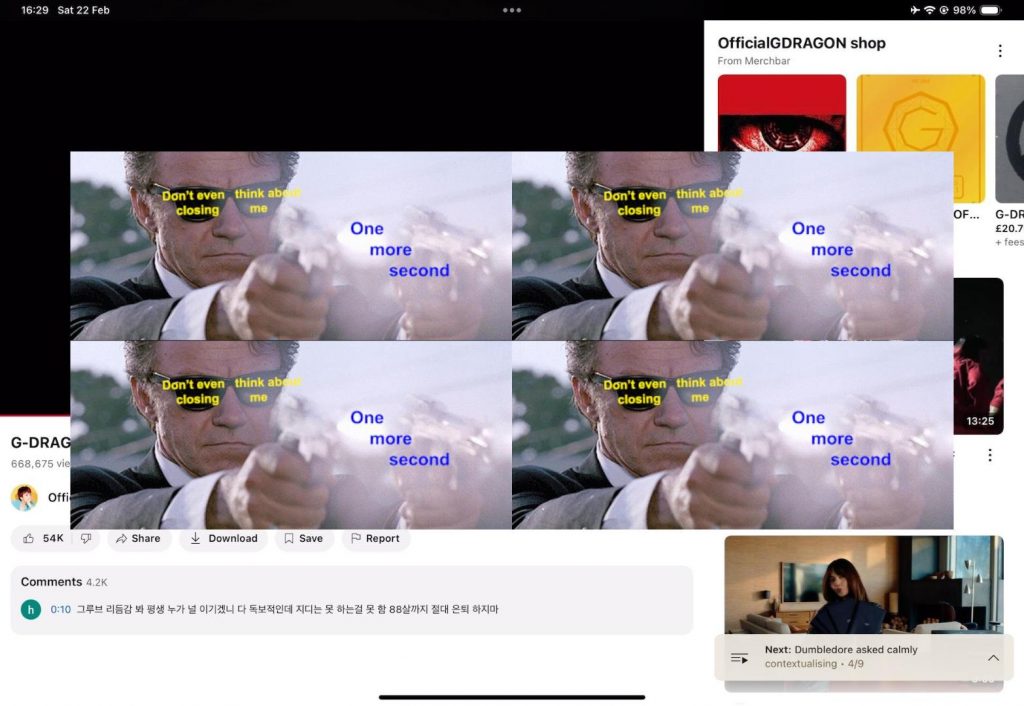
The situation we focused on for this project is auto-play capitalism. Streaming platforms manipulate people’s perception of time by using auto-play, algorithmic recommendations, and binge culture to eliminate natural breaks. This system ignores the concept of “Crip Time”, instead exploiting people who perceive time differently, especially those with neurodiverse disabilities. Auto-play keeps users in an endless loop, replacing natural pauses with seamless shifts. Auto-play capitalism thrives on exhaustion, obscuring the distinction between choice and compulsion. Attention has become fragmented due to the abundance of content and the lack of structured breaks. Instead of deep engagement, users encounter a state of perpetual distraction.
The solution we came up with is to choose popups as an intervention because they are intrusive, disruptive, and difficult to ignore – ideal for breaking the auto-play cycle. We designed a range of different popups, including reminders, sarcastic, and demands. It turned out that the popup outcomes communicate the chaotic nature of the internet. Our final intervention will be a plug-in, and we made a demo film for it, using YouTube as a fundamental platform. I took part in the audio editing and animation. Exploring different types of voice and popup escalation animations makes interruptions more effective and fun.
Annotated Bibliography
Gerbaudo, P. (2012) ‘Introduction’ Tweets and the Streets. London: Pluto Press. https://ebookcentral.proquest.com/lib/ual/reader.action?docID=3386687&ppg=1.
Gerbaudo highlights how social media plays a role in protests by “setting the scene” and evoking strong emotions. In other words, there is a rhythm and choreography implicit in seemingly spontaneous, leaderless movements. This is similar to the algorithmic rhythms of YouTube auto-play, showing how digital media can “choreograph” user behaviour by setting the pace and mobilizing emotions. Our popup plugin seeks to “Killing Rhythm”, a seamless, almost automated playback rhythm that interrupts binge-watching behaviour. At the same time, the concept of “Crip Time” advocates for a more fluid approach to playback. Gerbaudo’s argument reminds us that the rhythm of digital platforms, while often criticized, also promotes a degree of collective participation and emotional connection. Interrupting this rhythm can have a double-edged effect on the user experience: on the one hand, it can help to free the user from unnecessary over-immersion; on the other hand, it can interrupt the coherence and engagement that the user would otherwise derive from a continuous experience.
Harris, T. (2016) ‘How technology hijacks people’s minds’, Medium. https://medium.com/thrive-global/how-technology-hijacks-peoples-minds-from-a-magician-and-google-s-design-ethicist-56d62ef5edf3.
Harris mentions that tech products such as YouTube’s auto-play are designed to engage users by providing constant, immediate feedback and rewards, which coincides with the “Killing Rhythm” that we are trying to break in this constant consumption. The article explains how technology can manipulate users’ perceptions and behaviours to keep prolonging viewing, reinforcing the case for developing plugins to break this binge watching. The article essentially reveals how technology can be used to manipulate user behaviour, while also demonstrating a lack of user initiative when facing such design. It is also in this context that the concept of “Crip Time” to advocate a more flexible, user-centred time experience that breaks the repetitive rhythm. Our plugin aims to provide users with more active choices by interrupting auto-play and forcing them to reconsider and take control of their viewing habits. However, it also questions the concept of “automated convenience” put forward by the designers of the technology as to whether all automated features are truly in the best interest of the user in the long run. Thus, the article challenges us to think about how to find a balance between technological intervention and user initiative.
Mcluhan, M. and Fiore, Q. (1967) The Medium is the Massage: An Inventory of Effects, Berkley: Gingko Press. https://archive.org/details/pdfy-vNiFct6b-L5ucJEa.
This book pushes readers to look beyond the traditional “content-first” framework and concentrate on the “invisible forces” that lie behind technology and quietly impact on users’ ways of thinking and living. It provides a solid theoretical base for our project, demonstrating that auto-play has a “massage” effect on the user’s perception and sense of time rather than just being a feature. Our popup plugin aims to interrupt this automated “massage rhythm”, forcing users to become aware of their own viewing behaviour, thus cutting off the continuous experience shaped by the medium. Auto-play triggers binge watching not only because of its technical design, but also because users have long been accustomed to it. The authors remind us that media forms, once embedded in our lifestyles, create a “natural” environment. The discourse makes us realize that the time and rhythm driven by modern digital media is in fact a constructed rhythm, and that our plug-in attempts to disrupt this by striving for a more autonomous, non-compulsory experience of time for users.
Newport, C. (2019) Digital minimalism: Choosing a focused life in a noisy world. New York: Portfolio.
Social media and video platforms are examples of modern digital tools designed to use “intermittent reinforcement” to draw users in, which can lead to an unintentional addiction to an endless stream of information, according to Newport. He advocates for digital minimalism, which is the thoughtful use of technology to enhance rather than distract users’ core values and life goals. Our plugin hopes to break habitual, continuous consumption patterns by interrupting the auto-play rhythm, which is supported by Newport’s argument that people lose the ability to self-manage when they are controlled by a designed rhythm. Interrupting the “Killing Rhythm” helps users revisit and regain control of digital time, while “Crip Time” emphasizes the importance of breaking out of efficient or linear time boundaries for more self-reflection and deeper experiences. Newport’s concept also emphasizes the importance of “deep reflection” and “solitude” – only by leaving the pace of time kidnapped by technology can users truly have a dialogue with themselves and find a more meaningful life.
Song, Yehwan (2024) ‘(Whose) World (How) Wide Web’, Instagram. https://www.instagram.com/p/C2X0OJlrwNH/?igsh=QkFmeF92WWNBaw%3D%3D&img_index=1.
Using parentheses in the title and the overall visual composition, Song directly questions the attribution and operation mechanism of digital space. This seemingly fragmented and suspenseful way of expression not only breaks audience default impression of a coherent cyber world, but also reveals the inherent instability and multiple interpretative possibilities of the digital medium. The renaming and combination of “world” and “web” in the work is a metaphor for the diversity and unconventionality of digital space-time. Through visual references, we can see a challenge to the normative rhythm and flow of time in the digital world. Our popups create an artificial break that disrupts the user’s immersive consumption experience, much like the rearranged and fractured images in the visual reference. In addition to offering us visual inspiration, the works encourage deep experiment on the interplay of power, time, and rhythm in digital media, strengthening the theoretical foundation for our efforts to challenge the status and create new digital experiences in our technological practice.
Tsang, D. (2016) Fragmented time. https://www.behance.net/gallery/45820185/Fragmented-Time-.
This piece of visual reference proposes a non-linear, fractured experience of time by breaking it down into separate and discrete fragments. Tsang’s work dissects time into multiple “fragments” by presenting analogue computer screen-recorded animations and user consumption of social media. This kind of treatment reflects the “Killing Rhythm” – by interrupting the original rhythm, people are forced to feel and understand the flow of time again in the fragmented time. “Crip Time” challenges the traditionally efficient, linear, and mechanized view of time, and Tsang’s visual language suggests that time is not static and fixed but can be reorganized and deconstructed. By intentionally disrupting YouTube’s auto-play feature, our popup plugin applies this concept by challenging and redefining the normal rhythm of viewing, breaking the habitual continuity of viewing, and allowing the user to experience a more varied, and perhaps even rebellious, state of time. The film reference not only provided visual and conceptual support for our project, but also inspired us to think about how to apply the discontinuities and fragmented rhythms of time to practical design.