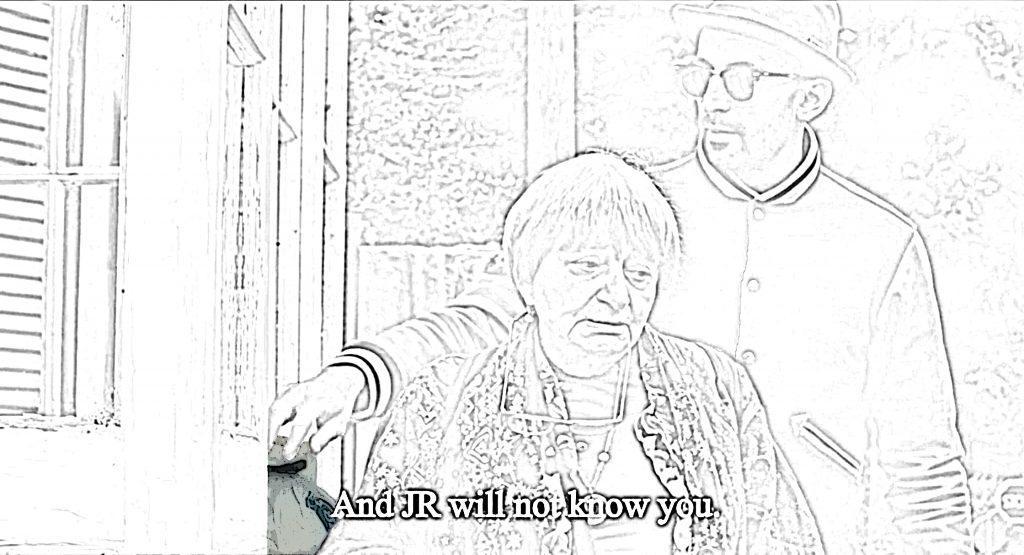
In this flip‑book project, I interrogate how iterative visual sequences can evoke the unexpected beauty of sadness inherent in the moment when Agnès Varda and JR are stood up at Jean‑Luc Godard’s doorstep in Faces Places, transforming absence into poetic presence (Brody, 2017). I wonder, how does repetition heighten emotional immediacy? What new meanings emerge when a cinematic moment is decomposed into fifty silent frames? Drawing on Johanna Drucker’s concept of graphic interpretation as performative knowledge production, each flip‑book frame becomes an interpretive act that reframes absence as affective presence (2014, pp. 180–192). Echoing Barthes’ call to relinquish authorial intent, this project’s sequencing empowers the viewer to co‑author meaning from absence itself (1977, pp. 143–148). Critically, I engage Varda’s ethical use of omission to foreground vulnerability and empathy in documentary form.
Annotated Bibliography
Barthes, R. (1977) ‘Death of the Author’ Image, Music, Text. London: Fontana Press.
- Barthes’ seminal essay challenges the traditional notion of authorial authority, arguing that the creator’s intentions should not confine the interpretation of a work. In the context of my project, this perspective invites viewers to engage with the emotional depth of the scene independently of Godard’s personal motivations or Varda’s intentions. By iterating the scene through graphic design, I enable a multiplicity of interpretations, allowing the audience to find their own meanings and emotional resonances within the visuals.
Brody, R. (2017) Agnès Varda and JR’s “Faces Places” Honors Ordinary People on a Heroic Scale. Available at: https://www.newyorker.com/culture/richard-brody/agnes-varda-and-jrs-faces-places-honors-ordinary-people-on-a-heroic-scale (Accessed: May 1, 2025).
- At the end of Faces Places, Varda tries to reconnect with Godard, but Godard ultimately rejects her. Themes of memory, friendship, and the passage of time are highlighted in this emotionally complex moment. The scene highlights the beauty of vulnerability and the poignancy of unfulfilled expectations. According to the review in The New Yorker, the film “celebrates the humanity of its subjects by transforming their images into public art,” emphasizing the emotional depth of personal relationships.
Drucker, J. (2014) ‘Designing graphic interpretation’ Graphesis: Visual Forms of Knowledge Production. Cambridge: Harvard University Press.
- Drucker investigates how visual representations serve as interpretive acts that create understanding rather than merely reflecting information. When I apply this viewpoint to my project, every graphic iteration turns into an interpretive lens that offers fresh perspectives on the scene’s representations of memory, absence, and emotional vulnerability. I wanted to highlight the beauty of grief by focusing on different elements of the same scene. My designs can thus be seen as active participants in the discourse, not just aesthetic reproductions.
Harrison, D. (2018) Techniques: Flip books. Available at: https://www.arts.ac.uk/partnerships/outreach/insights/how-to/techniques/how-to-techniques-flip-books (Accessed: May 1, 2025).
- Flipbooks are useful for examining time and emotion themes because they provide a tactile and sequential storytelling medium. The University of the Arts London highlights flipbooks as a method to “convey a story or message frame-by-frame and give the illusion of movement,” allowing for a nuanced exploration of scenes like Godard ultimately rejects Varda. This viewpoint can help guide my project, which employs the page-turner as a vehicle for critical commentary on subjects like emotional vulnerability and the intricacy of interpersonal relationships in addition to being an artistic endeavour.
Phillips, A. (2022) Faces Places and Agnès Varda’s Radical Generosity. Available at: https://visionandartproject.org/features/faces-places-and-agnes-vardas-radical-generosity/ (Accessed: May 1, 2025).
- This critical essay examines Agnes Varda’s filmmaking style and argues that it is based on empathy and collaboration as opposed to Jean-Luc Godard’s more transcendent approach. The article explores how Varda’s candour and openness subverts traditional, often male-dominated film narratives. Varda offers a critical viewpoint that is consistent with feminist theory and serves as the conceptual basis for my project by redefining authorship and storytelling through her emphasis on common people and interpersonal relationships.
Piotrowska, A. (2024) Agnès Varda’s the ethics and the strategies of omission. Available at: https://doi.org/10.1057/s41286-024-00205-x (Accessed: May 1, 2025).
- The purpose of this academic article is to investigate Varda’s use of omission and absence in her work, specifically focusing on the ways in which she makes use of visual means to navigate memory and loss. The discussion includes references to psychoanalytic theories, such as Lacan’s concept of the Mirror Stage, to analyse how Varda’s films reflect on identity and the self. This reference offers a unique lens through which to consider the fragmented and iterative nature of my flip book project, emphasizing the role of absence and repetition in constructing meaning.