From Online Anonymity to Material Presence
This research phase expands on my investigation of the emotional paradox in contemporary Chinese youth culture, focussing primarily on the tension between suppressed inner cries and outward displays of passive compliance—the former frequently released through anonymous digital spaces, the latter manifesting on the surface. Young people in Chinese online communities are increasingly using meme images as covert but effective channels for emotional release. This study aims to investigate whether these digital memes world widely authentically reflect users’ sentiments or merely mimic prevalent expressions of sarcasm and irritation without delivering genuine catharsis.
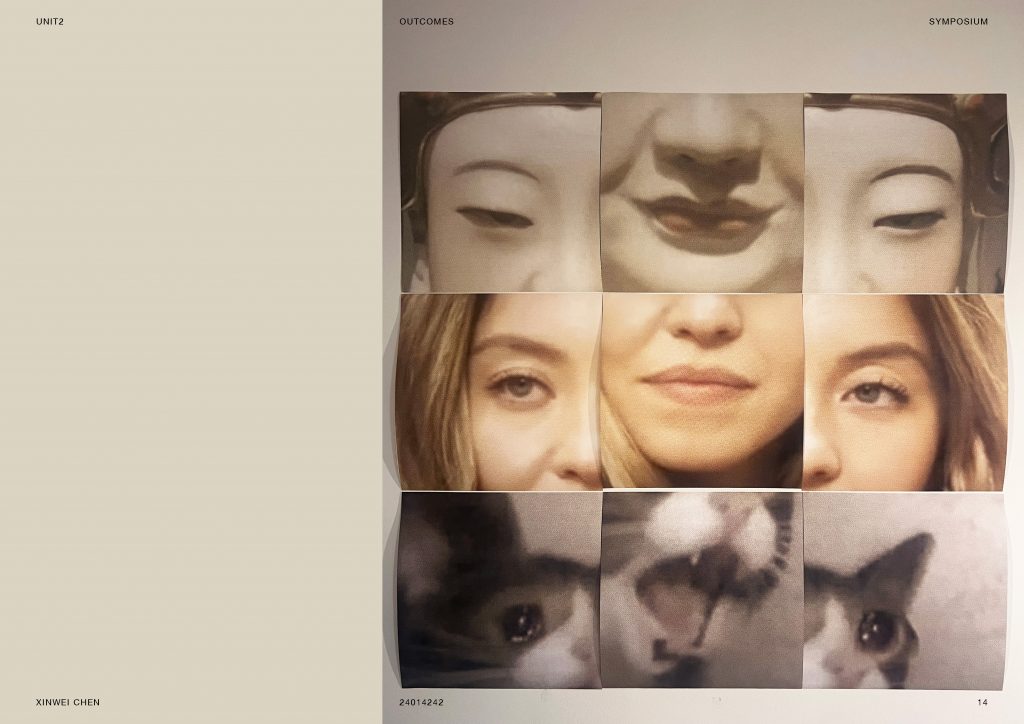
Building on the previous stage, where I enlarged digital memes into printed artefacts accompanied by reflective question cards, it deepens the research by analysing how anonymity, materiality, and social context interact in shaping emotional legibility. The work now considers how printed memes — detached from their networked anonymity — transform both the affective tone and the viewer’s interpretive experience.
Reflection
Enlarging and printing memes onto paper made visible the emotional distance between users’ online self-expression and their embodied selves. When appearing on screens, memes evoke instant resonance: they are the collective language of shared exhaustion and irony within anonymous communities. Yet when printed in large format, these memes appear heavy, clumsy, even hollow. Once a mask for emotion, humour starts to show melancholy, revealing the silence that lies behind laughter.
This outcome highlights a contradiction within contemporary digital culture: memes have the ability to collectively conceal vulnerability, but this commonality also silences individual voices. A helpful framework for this is provided by Schiffman (2014) and Nissenbaum & Schiffman (2018)’s concept of “meme templates as expressive repositories.” Although memes share emotional undertones, my research indicates that this expressive repository also disciplines emotional expression, transforming personal suffering into repeatable social codes.
Development
At this stage, I further examine whether collective interpretation can reshape individuality within shared emotions. Each enlarged meme is accompanied by a PVC-textured question card, prompting viewers to reflect and respond:
- What emotion do you believe this meme conceals rather than reveals?
- Does anonymity amplify or diminish this feeling?
Participants may write brief responses or alternative texts to affix onto the surface of the meme. Over time, these layered responses accumulate, forming a tangible record of overlapping interpretations—a visible emotional constellation replacing cyberspace’s intangible anonymity.
On a material level, printed memes embody the permanence of social expectations—fixed images of passivity and humour; while the plastic overlay visualises how emotions persistently circulate, blur, and contradict one another when shared in public spaces.
Positioning
This study starts from the Chinese context, situating Schiffman’s global theory within a localised affect economy shaped by social pressures, competition, and digital self-censorship. The phenomenon of “Buddhist-style youth”—often summarised by terms like “Buddha-like” and “lying flat”—embodies both resistance and compromise. Memes provide a socially acceptable outlet for this contradiction—enabling silent cries through humour.
According to Nissenbaum and Shifman’s theory of memes as an expressive repository, emotions can freely flow through an open digital space. By showing how anonymity becomes a double-edged sword that both protects expression and normalises emotional detachment, this study challenges that presumption. Vulnerability is reawakened by the shift from online anonymity to physical visibility: when memes are printed and displayed, viewers are forced to face the emotional realities that were previously hidden behind screens.
Next Steps
The next iteration will focus on analysing audience-generated responses, categorising them according to emotional tone and degree of personal disclosure. This process will help assess whether the installation genuinely elicits authentic expression or merely replicates online irony in physical form. I also plan to document the gradual visual evolution of each meme as responses accumulate—this dynamic archive will concretely visualise the collective yet fragmented emotional landscape of online communities.
Through this project, I seek not only to investigate whether emoticons can fully convey emotion, but also to reveal why emotional clarity is both sought after and evaded within digital culture. Printed emoticons become cultural mirrors: tangible imprints of a generation, recording cries within silence—where people find fleeting solace in shared imagery, yet continue to pursue authentic modes of expression.
References
Nissenbaum, A., & Shifman, L. (2018). Meme Templates as Expressive Repertoires in a Globalizing World. Journal of Computer-Mediated Communication, 23(5), 294–310.
Shifman, L. (2014). Memes in Digital Culture. Cambridge, MA: MIT Press.
Leave a Reply