Introduction
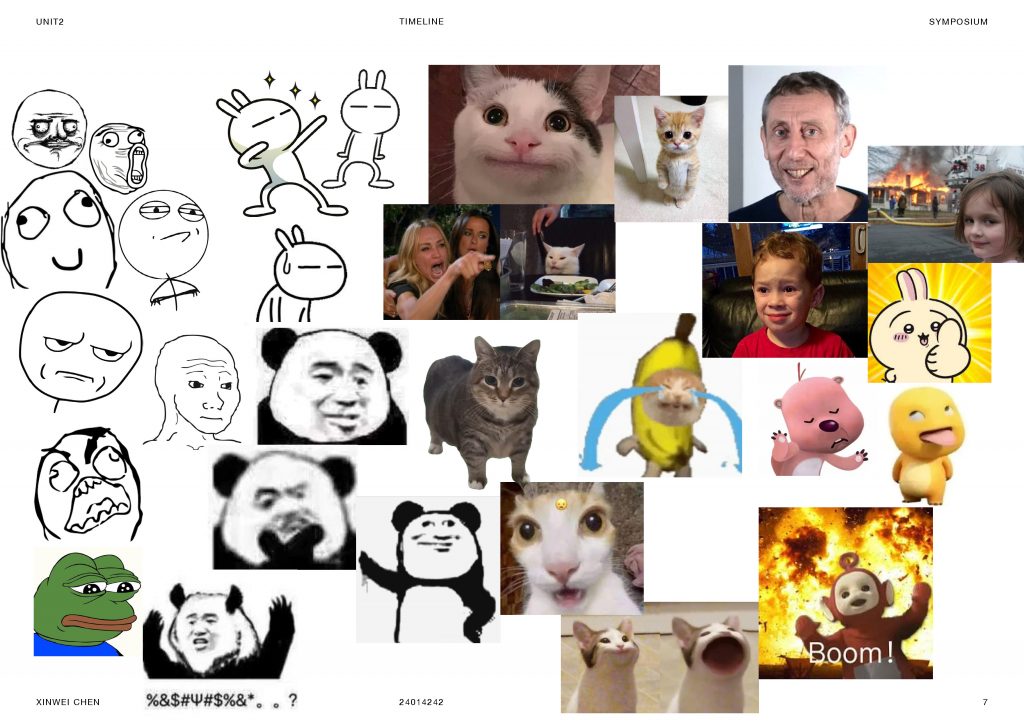
It seems that many young Chinese take on a mindset resembling “Buddha-like” or “Lying-flat,” signifying their disengagement from competitive and social pressures. But beneath this outward display of indifference lies a restless inner voice. Rarely are these emotions expressed orally; instead, they are transmitted via the digital anonymity of the internet. Online, emojis, memes, and amusing images proliferate as coded messages that express protest, grief, and humour. Through the dialogue with Deshna Mehta, this project explores how anonymity promotes these kinds of expression and how audiences in diverse cultural contexts view them differently.
Section 1: Anonymity and Access
Young people can agree, disagree, or relate collectively in anonymous spaces like forums, meme pages, and comment sections without disclosing their personal identities. However, access varies: some content is available worldwide, while others are restricted to Chinese online communities because of censorship and legal restrictions. Therefore, anonymous expression serves two purposes: it allows people to safely express their feelings and it pushes the limits of what can be said without fear of repercussions. These platforms serve as pressure valves as well as shelters.
Section 2: Interpretation and Cultural Context
Memes are never neutral; their meanings shift depending on cultural background. What one community reads as playful irony; another may interpret as political commentary. In the Chinese context, visual humour often becomes a proxy for forbidden speech. Short sentences, typographic play, and references layered with connotation create a “slow response” space where audiences decode meanings collectively. Anonymous meme-making is thus both an experiment and a test: what if we use humour as camouflage? What happens when the same meme travels into a global context? Interpretation itself becomes an act of participation.
Section 3: Formats of Dissemination
This project revolves around the format question: how can the quick, screen-based dissemination of anonymous memes be converted into more gradual, physical interactions? Inspiration comes from the Photo Book Café, Offprint, and zine collections in libraries, where small-scale publications are not just texts but spaces for alternative voices. In such environments, zines prioritise circulation over permanence and are purposefully informal, inexpensively made, and publicly available.
Translating this into practice, the project proposes three experimental routes:
Only text: extracted meme captions that mimic the “slow reading” style of zines by being printed in brief sentences across pages.
Only visual: reaction images that are separated from their textual anchors allow viewers to reinterpret feelings without the need for clear indications.
Combination: using screen printing or letterpress to combine appropriated images with broken captions, creating hybrid artefacts that undermine meaning.
Presented in a reading-room setting—tables, mock-ups, stacks of zines—these formats would simulate the communal, interpretive atmosphere of the café and library. Audiences are encouraged to leaf through, compare, and reinterpret, transforming anonymous online expressions into shared, situated acts of meaning-making.
Conclusion
By bringing anonymous online expression into curated, material formats, this project seeks to highlight the paradox of Chinese youth culture: outward passivity masking inner urgency. The internet provides anonymity and access, but also imposes cultural and political limits. In translating memes into tangible forms, the project creates a “room for interpretation,” where global and local audiences alike can confront the voices behind the masks of Buddhist-like and lying flat. The anonymous shouts, once hidden, are given new visibility.
Leave a Reply