Art Therapy

Kramer, E. (1971). Art as Therapy with Children. New York: Schocken Books.
Edith Kramer is a foundational figure in art therapy whose work foregrounds the intrinsic value of art-making itself. In contrast to approaches that prioritise verbal interpretation or psychological analysis, Kramer argues that the therapeutic potential of art lies primarily in the process of making rather than in the explanation of meaning. For her, the artwork does not need to be verbally decoded in order to function meaningfully.
This emphasis on process over interpretation is particularly relevant to this project. Kramer’s position supports the idea that visual and material practices can operate autonomously, without being subordinated to language or outcome-driven evaluation. Rather than positioning images as symbols to be interpreted, she frames them as active agents within a process of engagement.

Rappaport, L. (Ed.). (2013). Mindfulness and the Arts Therapies: Theory and Practice. London: Jessica Kingsley Publishers.
This edited volume explores how mindfulness-based approaches intersect with arts therapies, with a particular focus on attention, presence, and non-judgemental engagement. Across different chapters, the book emphasises slowing down perception, observing internal states without immediate categorisation, and allowing experiences to unfold without being named or evaluated.
For this project, the relevance of this text lies less in its therapeutic applications and more in its critique of habitual, automatic meaning-making. The book provides a useful contrast to contemporary internet culture, where emotional states are rapidly labelled, shared, and aestheticised through simplified language. Concepts such as mindfulness and attentiveness offer a framework for resisting this acceleration.
By drawing on this text, the project positions its graphic and editorial strategies as an invitation to pause and sit with emotional ambiguity, rather than immediately translating feelings into recognisable internet terminology. The reference supports the project’s emphasis on slowness, reflection, and non-instrumental engagement.

Schaverien, J. (1992). The Revealing Image: Analytical Art Psychotherapy in Theory and Practice. London: Routledge.
Joy Schaverien examines the role of images within art psychotherapy, arguing that images can hold meaning without being reduced to verbal explanation. She introduces the idea of the image as a site of presence, capable of containing emotional experience over time rather than resolving it into language.
Although Schaverien’s work is grounded in psychoanalytic theory, this project engages selectively with her thinking, focusing on the autonomy of the image rather than its clinical interpretation. Her resistance to premature verbalisation is particularly relevant to this research, which critiques how internet slang related to mental health can flatten emotional complexity through humour, irony, or repetition.
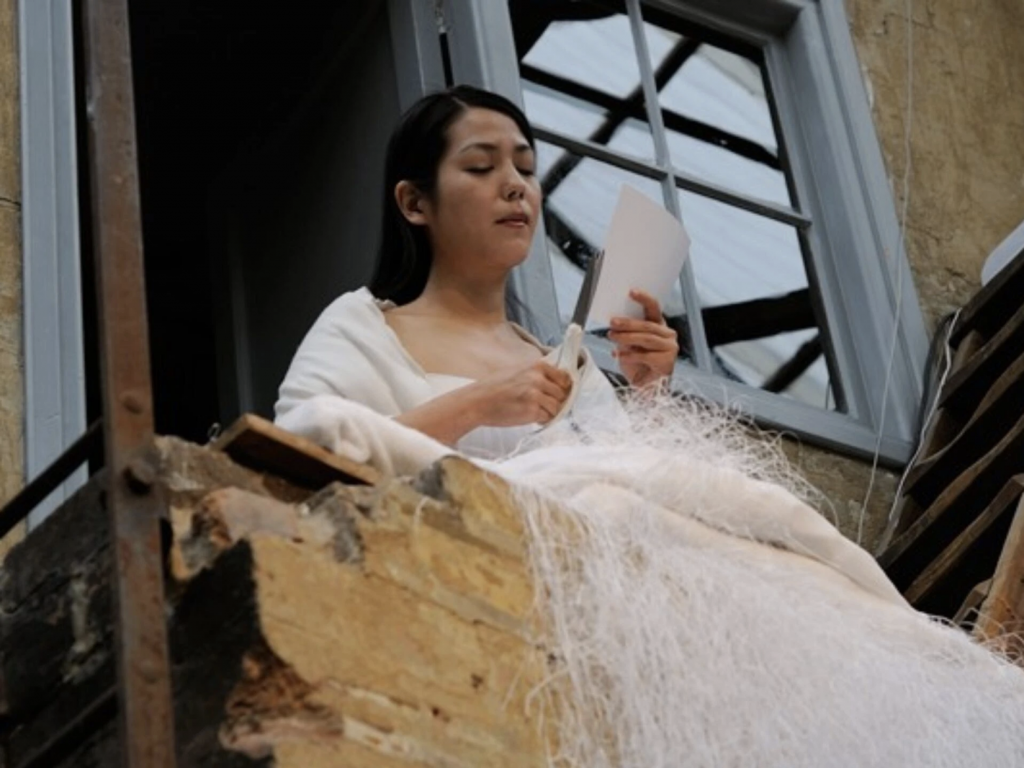
Works by Sachiko Abe.
Sachiko Abe’s practice centres on obsessive repetition and durational performance, most notably through her long-term engagement with cutting paper using scissors. Her work foregrounds process, labour, and bodily endurance, often producing large accumulations of fragile, repetitive forms.
Abe’s work is relevant to this project as an example of emotional intensity being externalised through repetitive, non-verbal action rather than narrative or explanation. The resulting forms do not “illustrate” emotion but embody it through time, effort, and physical engagement. This approach resonates with the project’s interest in emotional expression beyond linguistic labels.
Her work offers a reference point for understanding how emotional states can be materialised without relying on explicit emotional language.
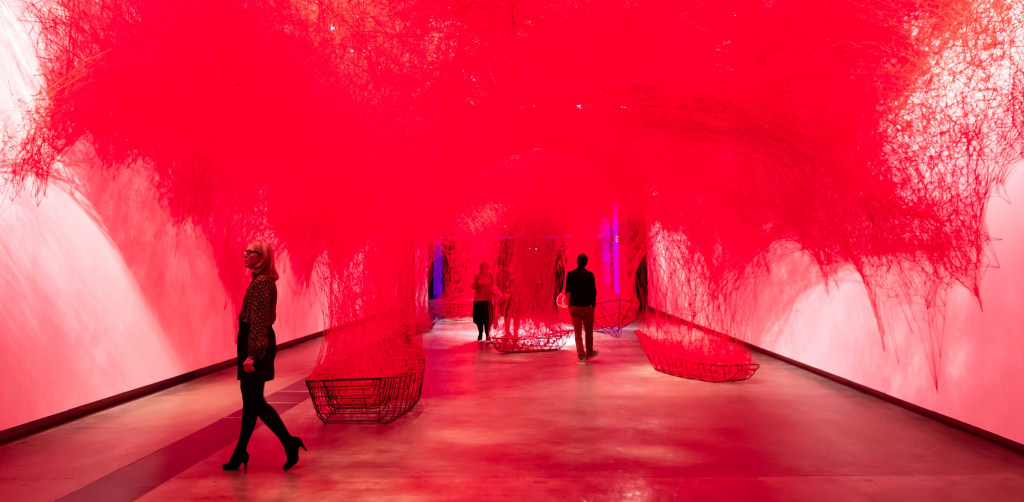
Works by Chiharu Shiota.
Chiharu Shiota’s installations often employ thread, everyday objects, and immersive spatial structures to explore memory, absence, and emotional entanglement. Her work constructs environments that viewers enter physically, experiencing emotion spatially rather than through representational imagery.
Shiota’s practice is relevant to this project as it demonstrates how emotional experience can be held within a constructed environment rather than communicated through direct language. The tension between fragility and containment in her installations parallels the project’s interest in how design can function as a holding space for affect.
Rather than presenting emotion as a message to be decoded, Shiota’s work supports the idea of emotional experience as something navigated and felt—an approach that aligns with the project’s critique of simplified internet-based emotional terminology.
Leave a Reply