01
Byung-Chul Han, In the Swarm: Digital Prospects
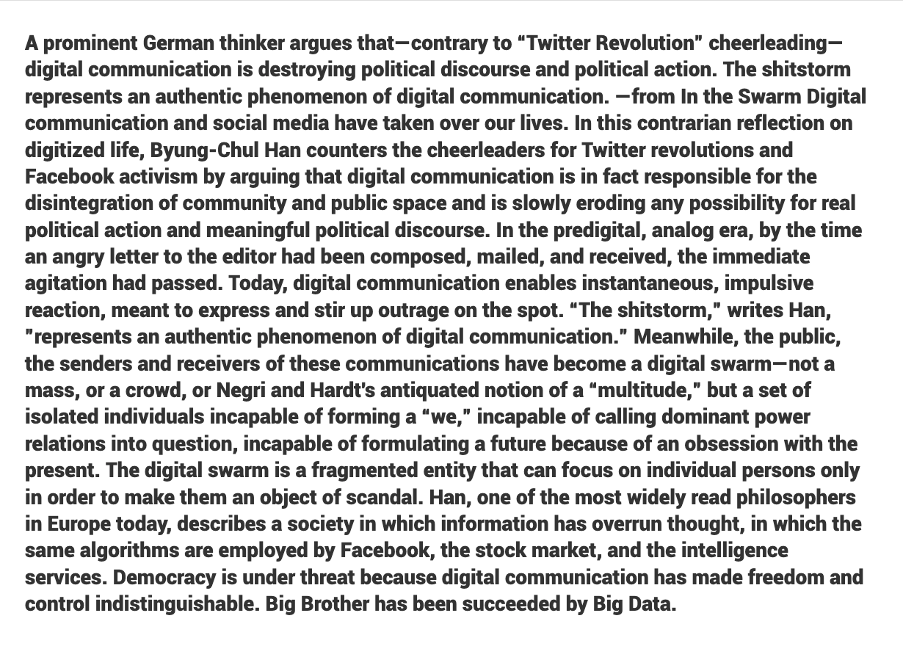
Han’s text helps me understand digital communication as a space of speed, exposure, and reaction. In his discussion of digital publics, communication is no longer slow, reflective or distanced. Instead, it becomes immediate, impulsive and highly visible. Emotional slang is shaped by this environment. It needs to be short, repeatable, and easy to recognise. In my project, I use fragmentation and visual noise to reflect this condition.
02
Lauren Berlant, Cruel Optimism
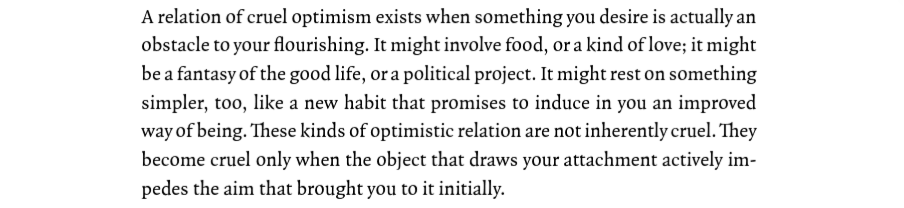
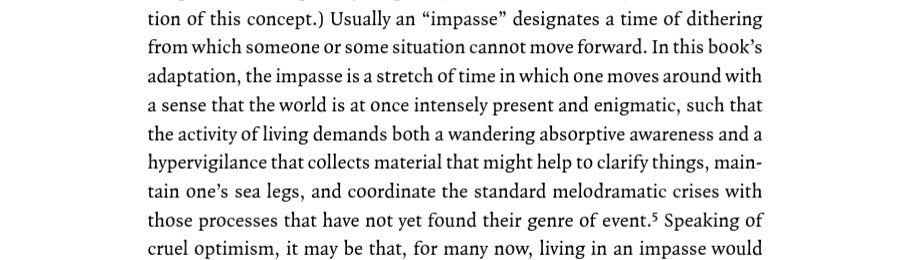

Berlant’s concept of cruel optimism helps me think about why people may remain attached to forms of expression that do not fully help them. In Cruel Optimism, the desired object can become an obstacle to flourishing. This is useful for my project because internet emotional slang can be comforting and limiting at the same time. A term like an emotional shorthand may allow users to speak about difficult feelings more safely, but it may also keep those feelings in a softened, unfinished or socially acceptable form.
This text allows me to avoid a simple moral judgement. I do not want to say that emotional slang is only harmful, fake or shallow. Instead, I understand it as an attachment. People use these words because they work: they create recognition, humour and temporary relief. However, their usefulness may also become part of the problem. If a painful feeling is always translated into a familiar online phrase, the phrase may protect the user from exposure while also preventing the emotion from being fully articulated.
Berlant helps me think about emotional slang as a form of attachment. These words may help users speak about difficult feelings, but they can also keep those feelings in a softened and unfinished state. The comfort of the word may become part of the problem.
03
Whitney Phillips and Ryan Milner, The Ambivalent Internet: Mischief, Oddity, and Antagonism Online
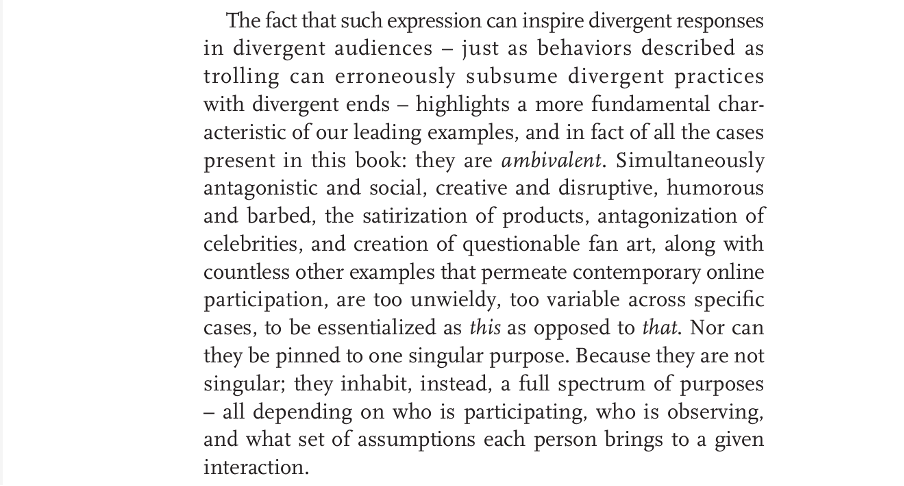
This text helps me avoid a one-sided critique of internet slang. Emotional memes and slang are not simply empty or harmful. They can create recognition, humour, and shared experience. However, the same forms can also flatten pain and make serious emotion harder to address.
04
Sara Ahmed, The Cultural Politics of Emotion
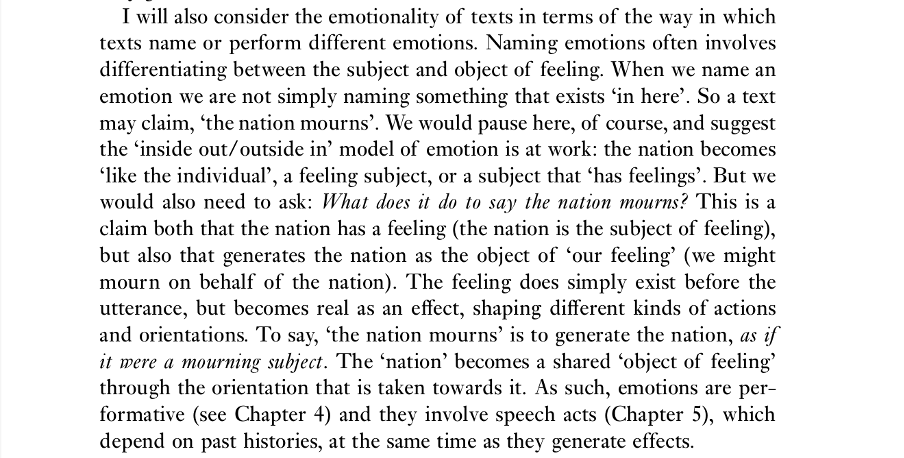
Ahmed helps me move beyond the idea that emotion is a purely private or internal state. Instead, she shows that emotions work through circulation, attachment, and relation. They move between subjects and objects, and they help create boundaries between self and other, inside and outside, private and public.
This is useful for my project because Chinese internet emotional slang does not simply describe feelings. It also participates in the social life of emotion by making certain feelings visible, repeatable, and shareable in public communication.
Bibliography
Ahmed, S. (2004) The Cultural Politics of Emotion. Edinburgh: Edinburgh University Press.
Han, B.-C. (2017) In the Swarm: Digital Prospects. Translated by E. Butler. Cambridge, MA: MIT Press.
Berlant, L. (2011) Cruel Optimism. Durham, NC: Duke University Press.
Phillips, W. and Milner, R.M. (2017) The Ambivalent Internet: Mischief, Oddity, and Antagonism Online. Cambridge: Polity Press.
Leave a Reply