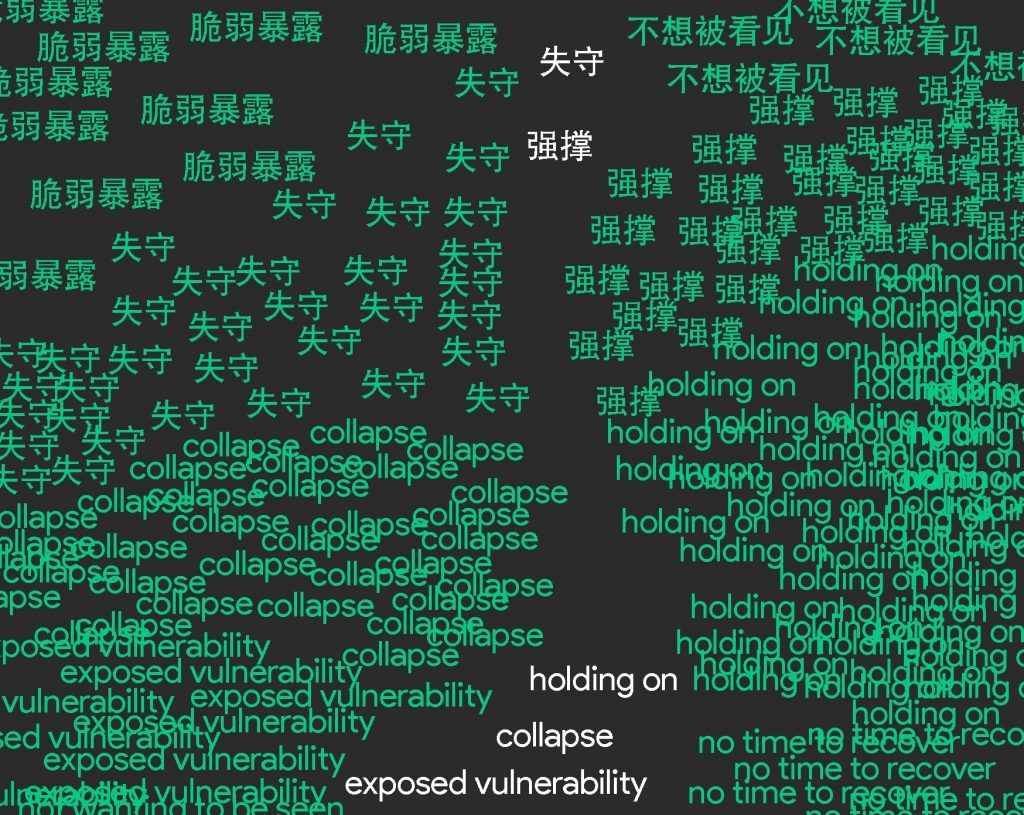
My enquiry investigates how Chinese internet slang compresses complex feelings into short, recognisable and shareable expressions. Focusing on nine selected terms, the project asks how these words help users communicate difficult emotions quickly, while also softening, simplifying or hiding what is harder to say.
This project developed from my earlier work, A Dictionary of Chinese Internet Slang, where I collected emotional online expressions and explored pixelated, digital visual styles. However, the first outcome was mainly descriptive and did not clearly define its audience or critical position. In this stage, I return to the dictionary format, but use it as a critical structure rather than a neutral container of definitions. Each entry includes pinyin, literal translation, etymology, examples of use and a hidden emotional layer. Through this structure, I explore the gap between the surface meaning of a word and the more complex emotional experience behind it.
My studio practice combines publication design, typography, material experiments and image manipulation. I use tracing paper to suggest partial visibility and emotional concealment and halftone meme residues to transform humorous internet images into unstable emotional traces. These methods allow the publication to move between clarity and ambiguity, definition and residue, surface expression and hidden feeling.
The enquiry is relevant to young Chinese-speaking internet users who already use these expressions in everyday digital communication. It is also relevant to graphic communication design because it explores how typography, materiality and publication structure can question the limits of language, and reveal what familiar digital expressions leave unsaid.
Leave a Reply